
How To Not Be Stuck
The world is full of people who want to change, who say they need to change, but remain stuck.*
I look at one of those people in the mirror every day.
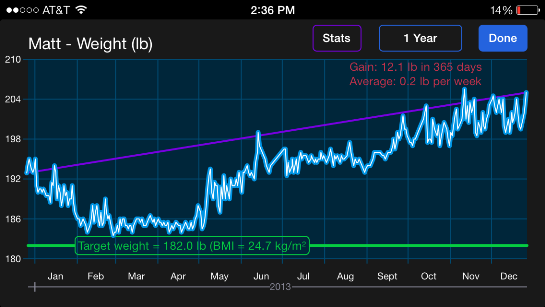
The above chart illustrates someone who says his Ideal Weight is one number and, yet, continues to eat in a manner contrary to weighing that anytime soon.
* * *
I have a theory that (when our mindfulness is low) our Survival Instinct is what really drives our behavior.
The problem is there’s a mis-match between how our brain (specifically the middle/limbic/emotional part of our brain) processes stimuli and actual threats (to the extent that any threat actually exists at any given time).
Yes, if there is a real and clear danger to our person or people near us, it is necessary to invoke the flight-fight/freeze response and deal with the danger appropriately.
Unfortunately, much of what happens in our day-to-day lives is seen a “mortal threat” and evokes a form – albeit lower in intensity – of the fight/flight/freeze response. Examples include: getting mad in the car, fear of public speaking, etc.
What’s common to all these situations is a perceived fear of “not-being-okay” and dealing with the “upset” in a non-resourceful way, or put another way, getting emotionally charged in a negative and elevated manner, out of proportion to the actual upset or situation.
The other, more common form, of this response is being uncomfortable with discomfort. To name but one example, there are times when we eat, not because we are actually hungry, but because we feel a bit bored, or anxious, or . . . whatever.
So we eat. (Or at least I do.)
Why?
Because eating makes us feel okay, It makes feel in control, or safe.
There are other forms of this: being bossy, being passive, working extra hours, exercising intensely, . . . . Whatever “tool” we can use to feel better, we do – and then we over-use it.
What it always comes back to is that we react in cave-man ways to modern issues.
What’s the antidote?
Increased awareness.
With a greater sense of what we’re experiencing, feeling and thinking we can make wiser choices in each moment.
How do we increase our awareness?
Meditation.
* * *
* I was going to make this post about someone I spoke with recently, who decided not to follow through on a commitment, and decided that a change she said she wanted wasn’t that important. But I realized that I have my own issue(s) and that I would be better served by focusing on what I want to change.